
Every day, millions of paper napkins are used in various settings. While producing these napkins requires water, significant efforts are made to minimize water consumption. Napkin water conservation focuses on reducing freshwater usage in manufacturing and ensuring that water is treated and returned to nature.
The goal is to produce soft, reliable napkins while conserving water and other resources. By making thoughtful choices, consumers can support environmental conservation and smarter resource use.
Key Takeaways
- Even though paper napkins require water to produce, most of it is treated and returned rather than lost.
- Recycled paper, modern closed loop systems, and water based inks help mills achieve significant water savings.
- Knowing the water footprint helps buyers make the switch to more earth friendly napkins.
What “Napkin Water Conservation” Really Means
Napkin water conservation is simply about lowering the amount of freshwater pulled into papermaking. Most of the water cycles back after treatment, but small amounts are consumed through evaporation or bound in the sheet. By choosing napkins made from recycled materials instead of virgin paper, buyers support eco-friendly napkin options that reduce water usage and create less waste compared with cloth napkins vs paper.
Where Water Shows Up in a Paper Napkin’s Life
Water is part of every stage of making single use paper napkins. It begins with fiber prep, where virgin pulp or napkins made from recycled materials are mixed and refined. On the papermaking machine, water flows through showers, dilution systems, and cooling. Extra water is used for cleaning and later sent to wastewater treatment before being reused or released.
Printing and converting use very little by comparison, but tissue grades can demand more water for softness and brightness. Each 1 paper napkin may seem small, yet the full process links back to real water usage.
Intake vs. Consumption: Why “90% Returned” Matters
In Europe about 92–93% of the water used in paper production is treated and returned to the environment in good quality, not lost forever. In the United States, the American Forest & Paper Association reports that about 88% of the water used by pulp and paper mills is cleaned through wastewater systems and returned to rivers and lakes.
For single-use paper napkins, both the intake (fresh water drawn into the system) and consumption (water lost through evaporation, moisture in the napkin, or sludge) matter. The key to reducing water usage lies in closing water loops inside mills, reusing clean water, and minimizing pollutants so that discharged water remains safe.
Choosing napkins made from recycled materials and sourced from mills with strong wastewater treatment systems enables buyers to make more eco-friendly and sustainable choices.
How Much Water Does Papermaking Typically Use?
Water use in papermaking varies a lot by paper grade and technology. In the United States, pulp and paper mills often use about 17,000 gallons per ton (~64 m³/ton) of paper produced.
Modern tissue mills, especially those using recycled materials, now often run in the 5-20 m³/ton range. Best practice machines have pushed that even lower, near 5 m³/ton for virgin tissue pulp. (Source)
Freshwater Use Ranges in Papermaking
| Mill type / grade | Typical m³/ton range | Notes / Source |
| Integrated kraft pulp & paper | ~ 30-60 m³/ton | Older or specialty operations, high water use under older tech. |
| Recycled fiber (deinking) | Lower half of above range | Using napkins made from recycled materials cuts water intake. |
| Virgin tissue machines | ~ 5-20 m³/ton | Especially with modern closed-loop systems. |
| Best-practice tissue (virgin) | ~ 5 m³/ton or less | Top-performing machines using efficient showers and reuse. |
Recycled vs. Virgin Fiber: What Changes for Water
Choosing recycled fiber over virgin fiber for paper napkins significantly reduces water consumption and supports more environmentally friendly napkin options. The water footprint is a crucial factor when comparing single-use paper napkins to cloth napkins or reusable alternatives.
According to the Environmental Paper Network, producing one ton of 100% recycled copy paper generates about 49% less wastewater than paper made from virgin fiber. Green America supports this with data showing that recycled fiber can reduce overall water use by up to 53%.
The main reason for these water savings lies in the process. Napkins made from recycled paper skip the water-intensive tree-to-pulp steps, significantly reducing water usage. Modern recycling mills also use advanced deinking systems that are more water-efficient. While specific figures vary depending on mill design, recycled materials generally require fewer liters or gallons of water per ton, making them a more earth-friendly choice.
Tissue-Grade Specifics (Paper Napkins)
Making single use paper napkins is different from other paper products because tissue must stay soft, clean, and safe for contact with food. That level of quality once meant using more wash water, but modern tissue lines now recycle water inside the system and operate at around 5–20 m³ per ton. The most efficient mills report results under 4 m³ per ton, showing what is possible when loops are closed.
These improvements come from fine-tuning showers, seals, and stock preparation, along with upgrading treatment so water can be reused safely. Choosing napkins made from recycled materials in these mills gives buyers an earth-friendly option that reduces emissions and water impacts compared with napkins made from virgin fiber.
Printing & Converting: Small but Not Zero
Even though most water use happens earlier in fiber prep and papermaking, printing and converting still leave a mark. At B.E. Green everything is under one roof with printing, converting, and paper production together. This setup avoids extra water handling that often comes with moving production across different facilities.
Our full color digital prints use food safe water based inks, which do not require harsh chemicals or heavy solvent washdowns. For you as a buyer, this means when you choose 100% recycled custom napkins from B.E. Green, you receive premium designs with minimized water impact that are earth friendly, compostable, and dependable in both feel and finish.
Paper Napkins vs. Cloth: A Water Snapshot per Use
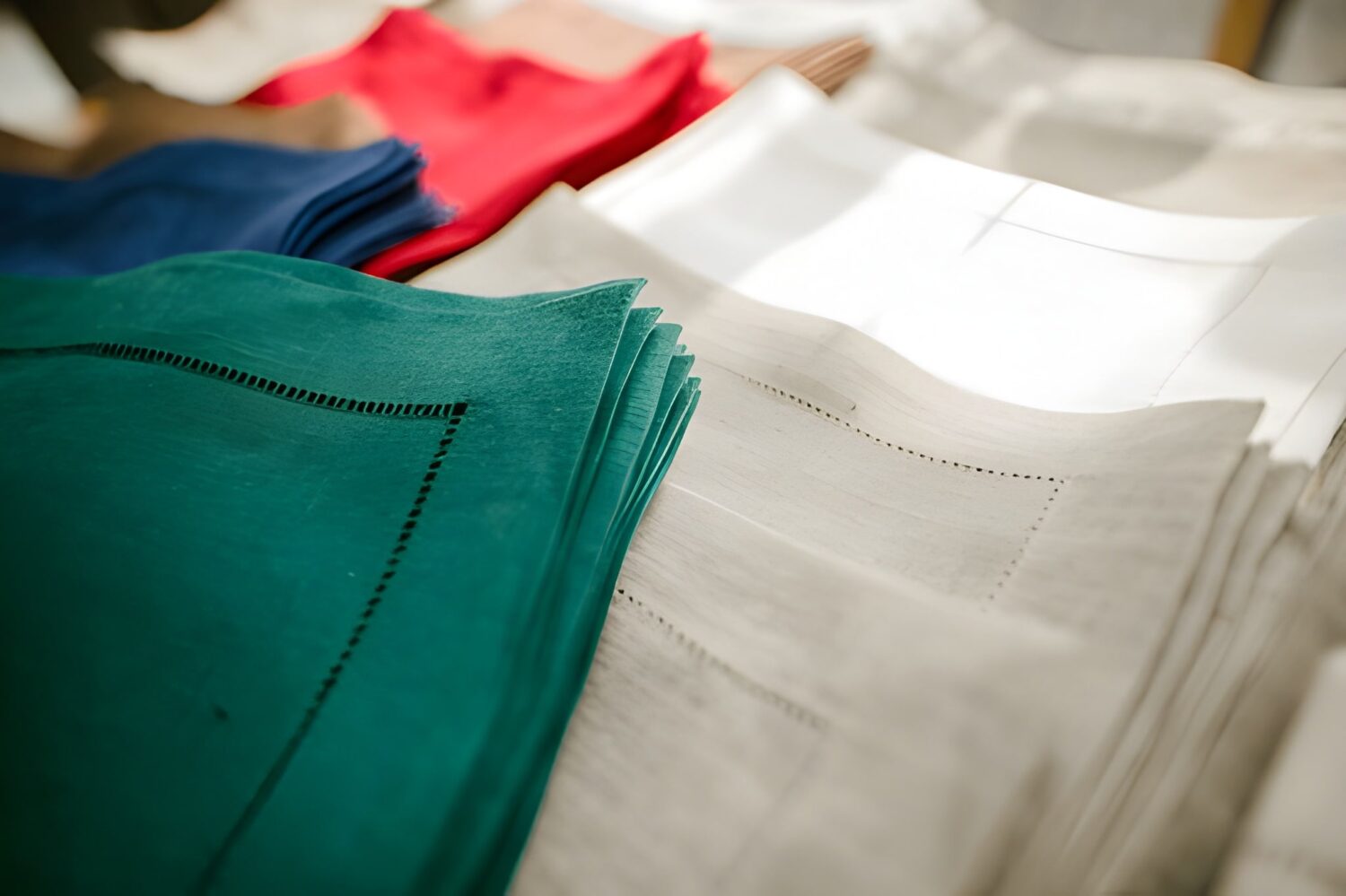
When comparing paper or cloth napkins, the biggest water factor for cloth is laundry. According to ENERGY STAR, a certified washer uses about 14 gallons per load, while a standard washer uses about 20 gallons, and older machines may use more than 30.
Here’s a simple example. If a restaurant launders 200 reusable cloth napkins in one ENERGY STAR load (14 gal), that works out to about 0.07 gallons (0.26 liters) per napkin per wash. With a standard washer at 20 gal, the number rises to 0.10 gallons (0.38 liters). By contrast, manufacturing a single-use paper napkin has been estimated at about 0.3 liters of water.
While cloth napkins can be washed and reused many times, they carry ongoing water use with each cycle. Single-use paper napkins made from recycled materials reduce that ongoing burden and provide an eco-conscious, earth-friendly option for businesses that want to switch from paper or cloth without losing convenience.
Per-use water – cloth vs. paper (examples)
| Scenario | Assumptions | Water per napkin (L) | Notes / Source |
| ENERGY STAR washer @ 200 napkins | 14 gal/load ÷ 200 napkins | 0.26 L | energystar.gov |
| Standard washer @ 200 napkins | 20 gal/load ÷ 200 napkins | 0.38 L | energystar.gov |
| ENERGY STAR washer @ 100 napkins | 14 gal/load ÷ 100 napkins | 0.53 L | Example calculation |
| ENERGY STAR washer @ 300 napkins | 14 gal/load ÷ 300 napkins | 0.18 L | Example calculation |
| Paper napkin (manufacturing) | One napkin production | 0.30 L | treehugger.com |
Hotspots & Fixes: Where Mills Actually Save Water
Paper mills can cut water use in several practical ways. These fixes matter for single use paper napkins made from recycled fiber, helping reduce waste and create more earth-friendly choices.
- Close loops and reuse: Mills use short and long water circuits, recycle “whitewater,” and even add membrane steps. This keeps systems efficient and means less water pulled in from outside.
- Upgrade machine systems: Better showers, improved seals, and refined dilution control in stock prep all help mills use less water. Many tissue best-practice studies highlight big savings from these changes.
- Stronger treatment: Robust primary and secondary treatment, and tertiary where needed, allow mills to reuse water safely. EU BAT frameworks set limits on effluent flow and pollutant loads, helping keep compostable, biodegradable napkins in line with sustainability goals.
What This Means for Buyers
When choosing napkins, it pays to ask suppliers about freshwater intensity per ton, the percentage of recycled fiber, and whether most water is treated and returned. Selecting single-use paper napkins or disposable paper made from 100 percent recycled materials from mills with closed-loop systems helps reduce water use, landfill impact, and greenhouse gas emissions. This approach lets businesses make eco-conscious choices while deciding between cloth napkins, cotton napkins, or reusable alternatives.
B.E. Green’s Water-Smart Approach
B.E. Green helps businesses make sustainable choices without compromise. Our napkins are made from 100% FSC Recycled paper, designed to use less water while still delivering the quality and color customers expect. By keeping manufacturing, printing, and converting under one roof, we streamline the process and avoid the extra handling that wastes resources.
Instead of traditional solvent-heavy printing, we use digital, water-based pigment inks that are safe for food contact and gentler on the planet. With fast 1–3 day fulfillment, low order minimums, and free ground shipping, we make it easy to go green and still receive napkins that are compostable, eco-conscious, and ready to perform at every meal.
FAQs
Why do some “low-water” mills still report high intake?
Local water quality, cooling needs, and product specs can boost intake even when most is returned clean after treatment. Ask for both intake and discharge numbers.
Does “waterless” printing exist for napkins?
In practice, digital water-based inks minimize process water and avoid solvent washups. The major water use remains in pulp/papermaking, not printing.
Does recycled content always have lower water usage than virgin?
Generally, yes, but range matters. Highly efficient virgin tissue lines can be very low; still, the literature shows significant average savings for recycled fiber.
What’s a quick supplier question to gauge water performance?
What’s your m³ of freshwater per ton of tissue, and what % of mill water is reused/returned?
Conclusion
Every napkin represents a choice that impacts the environment. By selecting napkins made from 100 percent recycled fiber, you support smarter water use, reduce greenhouse gas emissions, and keep products out of the landfill through compostable design. Even the choice of one napkin at a meal or three paper napkins a day creates a ripple that matters.
At B.E. Green, sustainability is built into every detail, from our recycled paper mill to our water based printing and reliable service. The result is napkins that look beautiful, feel premium, and contribute to a healthier planet.
Choose B.E. Green and make each meal a step toward going green. For any questions, call us at 888-370-4544 and our team will be happy to help.